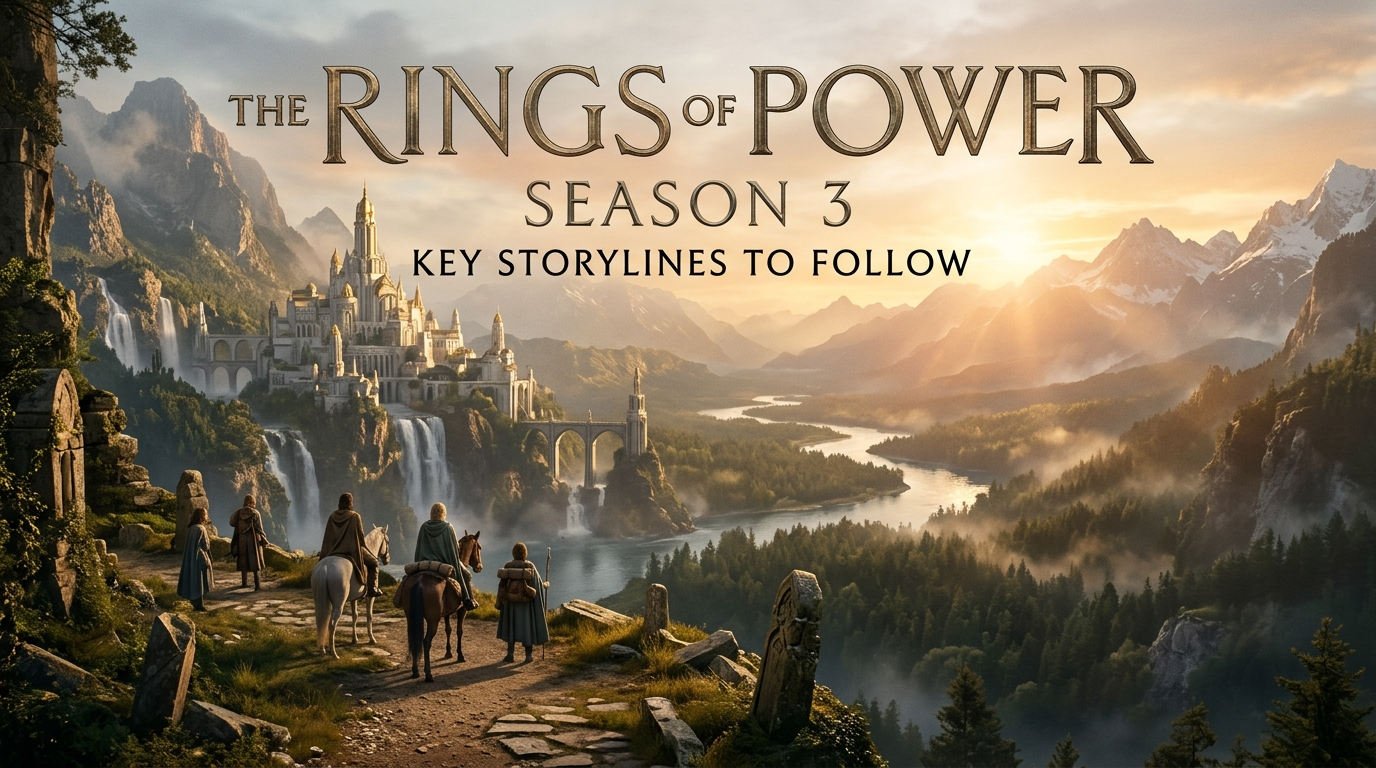
The Lord of the Rings: The Rings of Power returns to Prime Video on November 11, 2026, with a third season set several years after the previous installment and during the conflict between the Elves and Sauron. Prime Video has confirmed a three-batch schedule: four episodes on November 11, two on November 18 and two on November 25. That distribution gives the season a distinct rhythm and provides an opportunity to assess how a broad ensemble handles a war whose stakes extend across Middle-earth.
This article is a spoiler-aware look ahead based on confirmed announcements and the story already on screen, not a report of episodes that have yet to air. The central question is not whether the production can stage another large battle. It is whether individual decisions remain intelligible as the conflict becomes more expansive and the forging of the One Ring approaches.
Sauron's strategy is more than brute force
The announced premise gives Sauron's pursuit of the One Ring a central place. That is a useful dramatic focus because power in this world is not simply the ability to defeat an army. It is the capacity to persuade, corrupt and reshape other people's choices. The tension becomes especially rich when characters believe they are using a dangerous instrument for a good purpose while failing to notice how the bargain changes them.
A strong season will show strategy operating on multiple levels: open military pressure, private deception, opportunistic alliances and the exploitation of existing fears. The most compelling Sauron scenes need not feature a spectacle of destruction. A conversation in which another character begins to rationalize an unacceptable concession can reveal just as much about his power. The narrative challenge is making that process specific rather than relying on an established villain's reputation.
The Elves face the cost of protecting what they love
Fantasy often portrays defenders of an ancient realm as morally straightforward. Yet protecting a home can demand painful compromises, particularly when leaders disagree about the urgency of a threat and the price of resistance. The Elves' struggle becomes more interesting when hope, pride and fear pull in different directions. Their longevity may offer perspective, but it does not eliminate political error or personal attachment.
As the war expands, pay attention to how the series distributes authority. Does someone make a difficult decision because they have earned trust, or because nobody else is allowed to question them? Can relationships survive when caution and courage point toward opposing actions? A meaningful victory in this setting may preserve more than territory; it may protect a principle that seems inconvenient in the middle of catastrophe.
Galadriel's choices need to carry history
Galadriel's role has been shaped by resolve, suspicion and a desire to understand a threat that repeatedly escapes easy definition. A time jump can create fresh circumstances, but it should not erase the emotional consequences of prior mistakes and attachments. Her credibility as a central figure depends on how she responds when certainty proves costly, not on whether she always identifies the correct course instantly.
The most revealing scenes may involve disagreement with allies. A warrior's authority can be tested by an opportunity to listen or reconsider, while restraint can demand more courage than immediate action. Rather than looking only for impressive combat sequences, observe whether the series gives Galadriel new information that changes the way she treats other people. Character development should be visible in decisions, not only in declarations.
Elrond and the pressure of impossible alliances
A war that touches multiple peoples requires diplomacy as well as force. Elrond is well positioned for stories in which trust is necessary but cannot be presumed. A negotiated alliance may unite groups that have incompatible priorities, and maintaining it can be more demanding than announcing it. The narrative becomes stronger when these tensions have material consequences for cities, families and leaders.
Watch how promises are interpreted after circumstances change. An ally may be willing to fight but unwilling to accept the same cost; another may recognize the threat while distrusting the proposed solution. This creates space for thoughtful dialogue within an epic framework. The audience should understand why cooperation is difficult even when the danger looks obvious from a distance.
For how a premiere establishes its longer dramatic promise, see the guide to judging a series beyond its pilot.
The Dwarves should not become background reinforcements
Middle-earth's peoples are most interesting when they retain their own cultures and internal disagreements. The Dwarves, for example, should have political priorities and family loyalties that do not simply mirror an Elven war plan. Decisions about territory, resources and heritage can make their participation consequential even when the larger enemy is shared.
A sprawling fantasy can lose texture if every secondary realm appears only when the central conflict needs additional soldiers. The stronger choice is to show how an external threat rearranges existing tensions. Does a promise made in desperation conflict with older obligations? Can a leader protect a community without isolating it? The answers can give the war a believable social scale and prevent the series from becoming a map of interchangeable armies.
The time jump must earn its place
According to the announced setup, the new season occurs several years after the previous events. Time jumps are useful because they can allow relationships, institutions and threats to develop beyond the immediate aftermath of a finale. They can also become shortcuts that conceal missing character work. The season's early episodes need to show what has changed and why those changes are plausible.
Look for detail rather than explanatory monologues. A city transformed by scarcity, a changed manner between former allies or a new political arrangement can communicate history economically. A character may have grown more cautious, more bitter or more committed, but those developments should have recognizable causes. The passage of time becomes dramatic when it changes the cost of action, not when it merely changes a caption on screen.
The forging of the One Ring must have human stakes
The One Ring carries enormous significance within the larger mythology. Television, however, has to make that significance felt in the immediate experience of characters who do not share the viewer's broader knowledge. A familiar artifact should not do all the narrative work simply because audiences know its eventual reputation. The process of pursuing it must reveal motives, constraints and consequences within this season.
A scene involving the promise of control is effective when someone has a reason to be tempted by it. Protection, grief, duty and ambition are distinct motives, and each would generate a different kind of compromise. If the story can show how the same object appears to offer salvation to one person and domination to another, the mythology becomes a live moral conflict rather than a collection of references.
Publisher announcements and verification
Amazon’s announcement supports the season-three episode schedule and confirmed story context. The discussion of character arcs is prospective analysis, not a recap of unaired scenes.