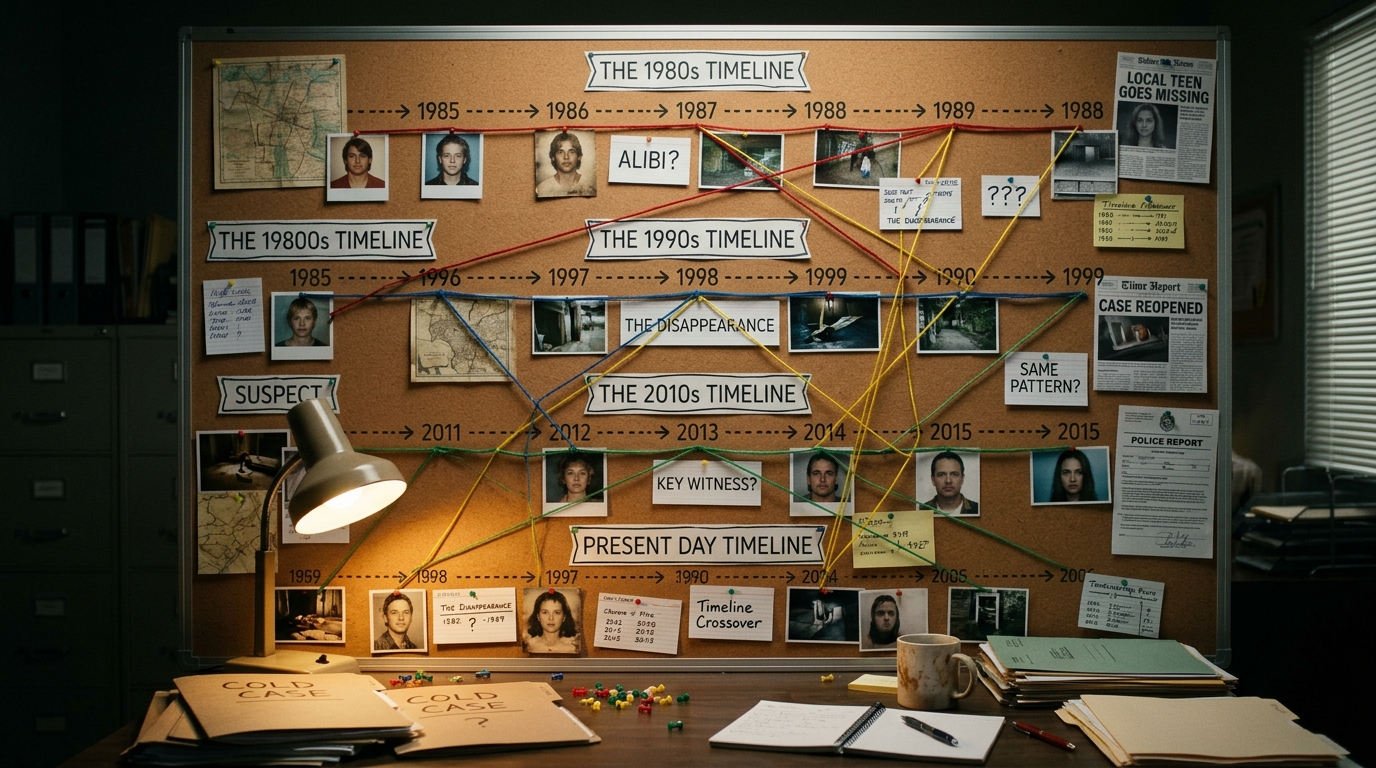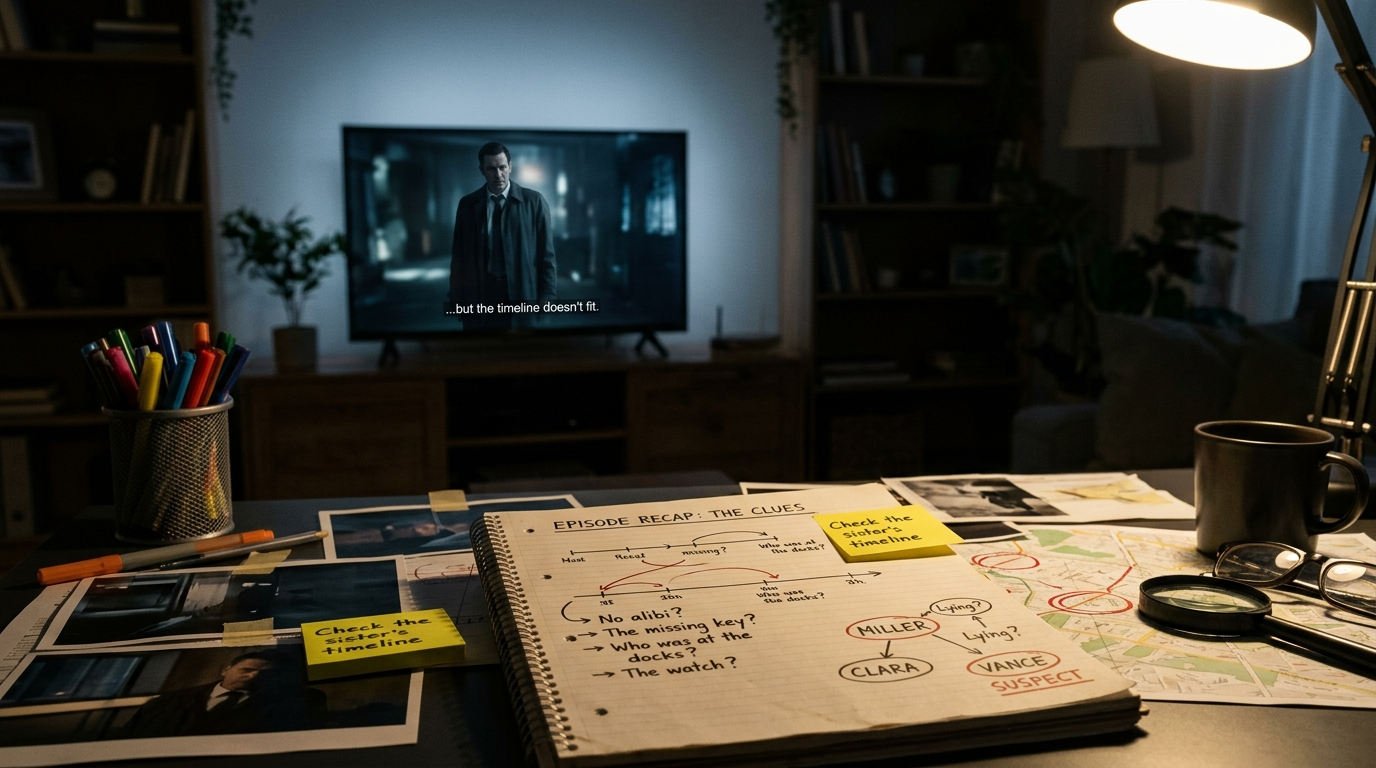
A mystery recap can be more valuable than a list of events when it tracks what the evidence actually establishes. Suspense stories often place clues beside misdirection: a timestamp, a sound in the background, a contradictory statement, an object that appears in the wrong location. Without a method, viewers may confuse a memorable image with proof or accept a popular theory simply because it has been repeated often.
The aim of a clue log is not to solve every case before the detective. It is to sharpen attention and make rewatches satisfying. A good log separates direct evidence from inference, records when each detail appeared and leaves space for the story to change what you think it means.
Record a clue in the smallest useful form
After an episode, write the detail in one sentence. “The witness said the meeting ended before sunset, but a later scene shows the lights on” is a useful record. “The witness is clearly lying” is an interpretation that may or may not follow. Specific observations are easier to compare when new information arrives, and they prevent a tentative suspicion from hardening into assumed fact.
Include the episode number or a rough scene description so you can find the evidence again. Do not spend the whole episode taking notes. If you are pausing every minute to examine a background object, the entertainment can become work. Choose a handful of potentially meaningful details and allow the series to guide your curiosity.
Separate evidence, testimony and atmosphere
Evidence might include a document, physical object or observable action. Testimony is an account given by someone who may be mistaken, selective or deceptive. Atmosphere creates a feeling of danger but does not by itself prove anything. A shadowed hallway, a suspicious musical cue or a character's nervous expression can encourage a theory without establishing a factual conclusion.
This distinction is one of the most powerful ways to improve mystery discussions. A character's statement can contradict a timestamp without either proving guilt. A camera angle may suggest an unseen presence without revealing who was there. When viewers name the kind of information they have, disagreements become more productive and the story's fair-play construction becomes easier to judge.
Track who has access to each fact
An audience may see a clue that the protagonist has not discovered. Two characters may witness the same event but remember different details. A third may possess information without understanding its significance. These asymmetries drive suspense, particularly in stories with parallel timelines or unreliable narrators. A clue log should identify who knows what, not merely what the audience knows.
Write a short note beside important revelations: viewer-only, detective knows, suspect knows or public knowledge. If the series later shows a character acting without information they have never received, the behavior may be entirely reasonable. Without a knowledge map, viewers can mistake deliberate dramatic irony for a plot hole.
Give every theory a possible disproof
A theory becomes more useful when you can say what would make it wrong. Suppose you believe a particular suspect was at the crime scene. What evidence would contradict that claim: an independently confirmed location, a different chronology or a witness who could not have seen them? Considering alternatives prevents your attention from selecting only the details that support a preferred answer.
You do not need numerical probabilities. Labels such as strong, tentative and speculative are sufficient. Update them when fresh evidence appears. The pleasure is not in proving yourself right at every step; it is in watching a narrative refine or overturn reasonable assumptions. Good mysteries invite revision.
For how to separate evidence from a theory in a difficult ending, see our spoiler-aware approach to explaining cliffhangers.
Repeated objects may change meaning
A photograph, key, sound or small personal possession can recur across episodes. Its first appearance may seem incidental; later scenes may reveal it was connected to another person or location. Track each appearance separately before concluding that repetition establishes a single hidden answer. Sometimes a motif matters thematically rather than as a literal clue.
Ask whether the repeated detail creates an actionable contradiction. An object found in two places could establish movement, but it might also be a similar object or an error in memory. The show should eventually provide enough context for the audience to evaluate the connection. A clue log helps you see that development without mistaking symbolic visual repetition for courtroom evidence.
Timeline questions deserve a separate column
Mystery dramas frequently complicate chronology through flashbacks, missing time or statements made after the fact. Write down confirmed event order when the show supplies it, and mark unclear intervals explicitly. A precise timestamp is different from a viewer's guess based on daylight or costume. Use broad labels when necessary, such as “before the party” and “after the phone call.”
This can prevent false contradictions. Two scenes may appear adjacent in an episode while occurring hours apart within the story. A character may describe an event from memory rather than from observation. If the log keeps these uncertainties visible, you can revisit them when the script clarifies the sequence instead of accusing the narrative of inconsistency too early.
How to distinguish payoff from coincidence
A satisfying revelation reinterprets details that the story made available. The audience may not have guessed the answer, but they can recognize the evidence in retrospect. A weaker solution depends on a secret fact introduced so late that no attentive viewer could have reasonably considered it. The difference is not whether the mystery was easy. It is whether the narrative made its eventual explanation fair.
After a significant reveal, compare it with the clues you recorded. Which observations gained meaning? Which assumptions were shown to be incorrect? Did the reveal explain apparent contradictions or create new ones? This exercise makes reviewing and rewatching more precise. It can also deepen respect for a subtle scene that seemed ordinary the first time.
A spoiler-safe clue ledger
| Episode | Observed fact | Whose claim? | What remains uncertain? |
|---|---|---|---|
| S1E02 | A key disappears | Camera-visible event | Who had access? |
| S1E03 | Alibi changes | Character testimony | Is another witness reliable? |
Sources and useful viewing resources
The example clue ledger is a writing and viewing technique, not a recap of a particular program. Check the linked TV directory only when you need to find authorized viewing.