A mystery told across several timelines can be exhilarating and disorienting. One episode reveals a conversation in the present, the next shows an earlier event that changes its meaning, and a later scene may expose the difference between what a character remembers and what actually happened. The story is not simply occurring out of order. It is controlling when the audience is allowed to understand each piece.
To follow this kind of series, separate event chronology from revelation order. The first describes when things happened within the fictional world. The second describes when viewers learned about them. Confusing those systems can turn deliberate suspense into frustration, but keeping them distinct makes the narrative far easier to enjoy.
Identify each timeline's reference point
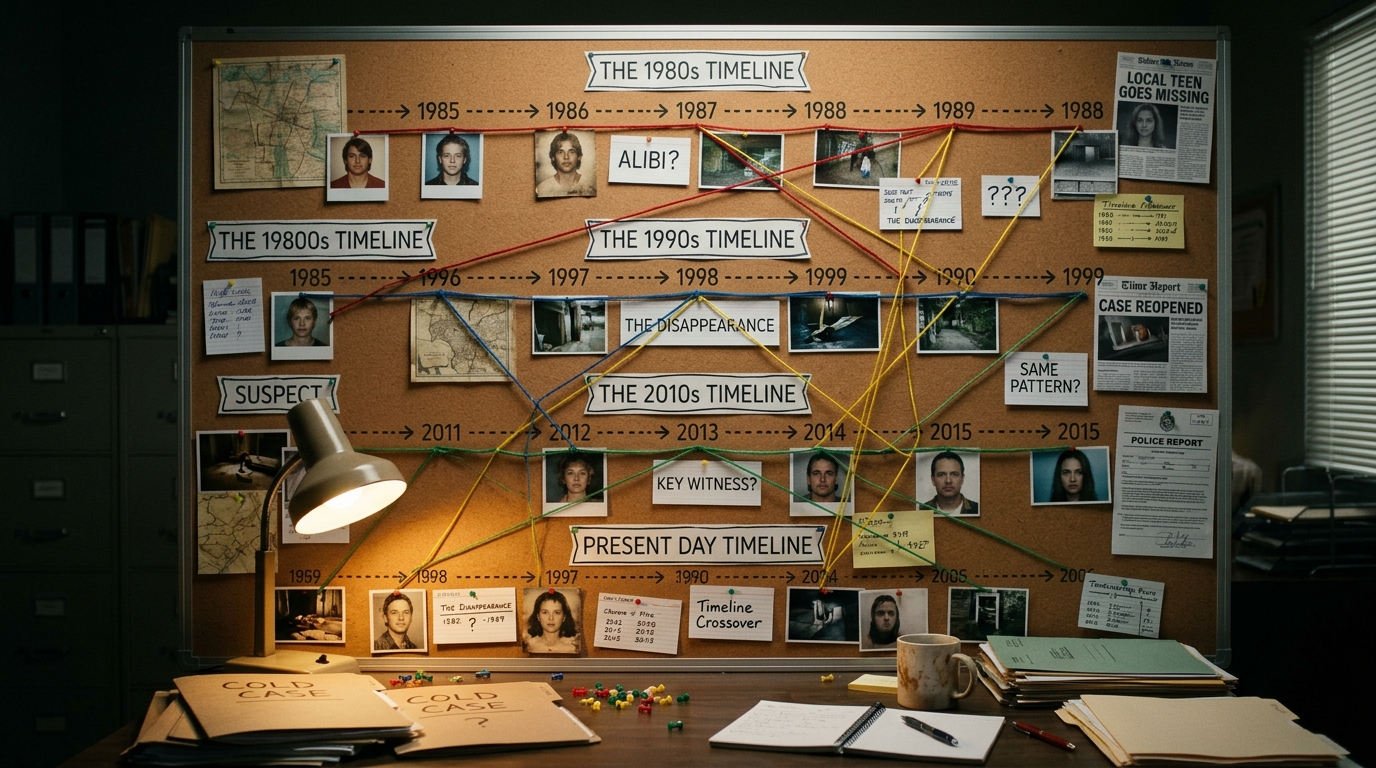
Start by locating a stable event: a disappearance, a disaster, a major relationship break or a public scandal. Other scenes may occur before or after it. This is usually more useful than trying to remember exact calendar years, particularly when the series avoids explicit dates or jumps by uneven intervals. Ask how each scene relates to the central event and write that relationship in ordinary language.
Visual indicators can help: hairstyles, locations, changes in technology, aging, color palettes or the presence of particular characters. But be cautious about treating a visual motif as an exact timestamp. Some productions use similar imagery across periods to create thematic echoes. When an episode deliberately conceals the time, mark the scene uncertain instead of forcing it into a chronology too early.
Keep event time and viewing time separate
Imagine that episode three reveals a letter written years before the pilot. The writing of the letter belongs early in the fictional timeline, but the audience's discovery of it belongs in episode three. That distinction matters because it affects what viewers could reasonably infer during earlier episodes. The letter may explain a character's behavior retroactively without implying that every other character knew about it.
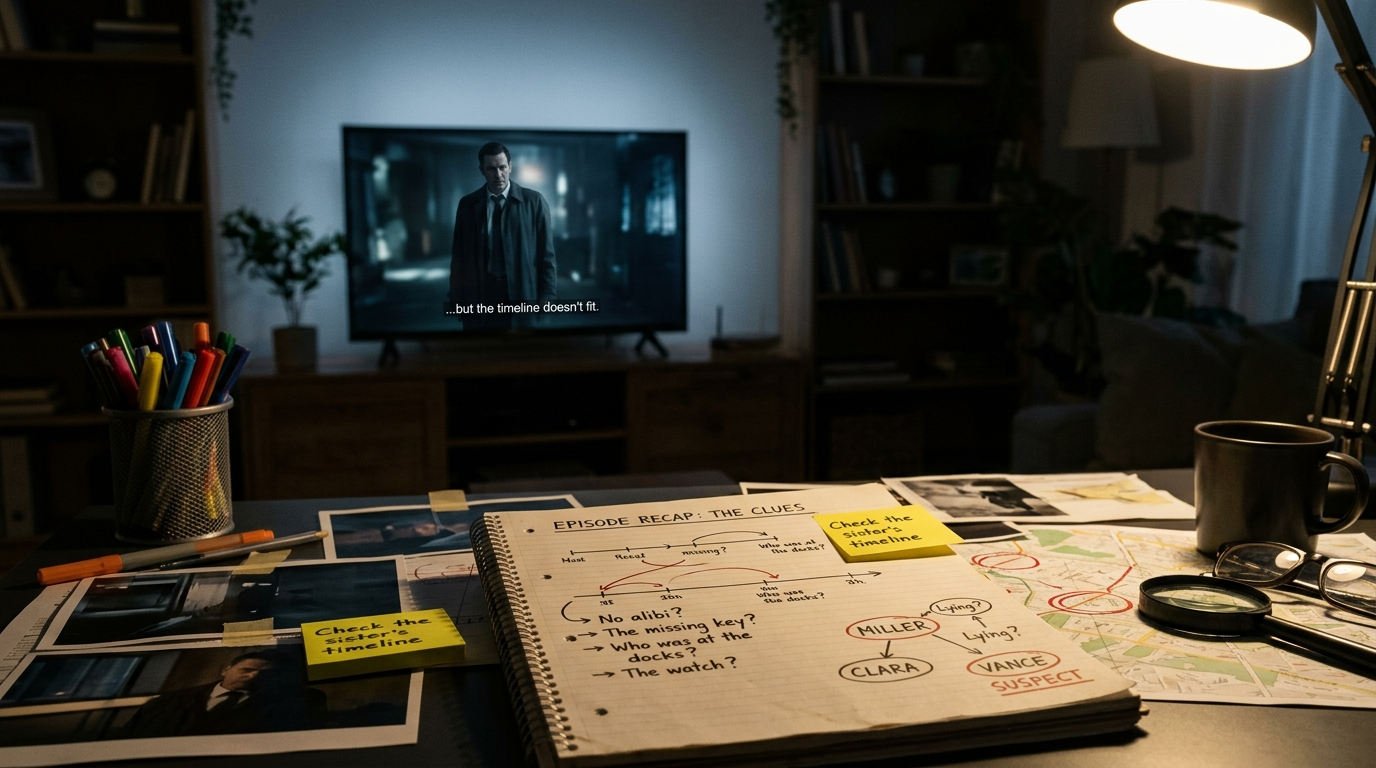
A simple two-column note can help: “When it happened” and “When we learned it.” You rarely need this for every scene. Record major turning points and revelations that change your understanding. The system becomes especially useful when later episodes revisit the same event from another perspective, allowing you to compare competing accounts without rewriting earlier knowledge.
Track what each character knows
Multiple timelines often operate alongside unequal information. One character may remember a past event imperfectly, another may be lying, and a third may know a detail the audience has not yet seen. A mystery becomes hard to follow when these perspectives collapse into one supposedly objective account. Make a small knowledge map: confirmed witness, hearsay, personal belief and undisclosed information.
Pay attention to the difference between silence and ignorance. Someone may know a fact but refuse to discuss it, while another genuinely lacks it. The script may not yet explain which is true. Treat those possibilities as hypotheses rather than answers. This preserves suspense without losing the logic of character decisions in the present timeline.
A repeated location can be a useful anchor
Stories that revisit a house, workplace, forest or town across decades often use place to show change. The same room may carry a different emotional meaning in each period. Details such as renovation, a missing object or changed ownership can help orient the chronology, but their deeper role is usually thematic. A familiar location may connect the consequences of one generation's choices to another's life.
When the geography becomes complex, sketch a minimal map with only the places where significant information was revealed. Note who occupied them in each period. This is not about solving the mystery mechanically. It is about making spatial relationships clear enough that you can focus on the characters' emotional experiences rather than constantly wondering where the scene is taking place.
For how to record discoveries without erasing uncertainty, see our guide to tracking hidden clues in mystery dramas.
Distinguish memories from objective flashbacks
Not every scene set in the past should be treated as a neutral recording. Some series present memories filtered through the person recalling them, and later accounts may correct or challenge details. A recollection can be sincere and still incomplete. Other productions use apparently objective flashbacks, where viewers are meant to trust the events even if characters have forgotten them.
Look for framing cues. Does a scene begin from a character's point of view or follow a confession? Are the images repeated with altered details? Does the series explicitly draw attention to uncertainty? Avoid declaring a character an unreliable narrator solely because a sequence feels dreamlike. The label should follow evidence from the storytelling, not become a way to dismiss any scene that disrupts a theory.
Compare events after a revelation, not before it
When a significant twist arrives, return mentally to earlier scenes and ask what has changed. Did a line acquire a second meaning? Does a previously confusing decision now follow from a fact the audience lacked? Or does the reveal contradict information the series presented as objective? These questions help distinguish an earned reinterpretation from a convenient rewrite.
You do not need to rewatch the entire season. Revisit the scenes directly linked to the new information, particularly moments in which someone made an important choice. A successful nonlinear mystery should become more coherent with reflection. The aim of the structure is to deepen understanding over time, not to make ordinary cause and effect permanently inaccessible.
Use a minimal timeline notebook
For each major event, record the approximate period, the people present, what happened, when viewers learned it and what remains disputed. Keep the entry to one or two lines. If the series contains two decades of events, broad labels such as “before the disappearance,” “during the investigation” and “years later” may be enough to begin. Precision can increase only when the show provides evidence.
Do not let the notebook replace enjoyment. If tracking every date makes you anxious, stop. Strong mysteries should offer visual and narrative orientation within the episodes themselves. Notes are an optional tool for viewers who enjoy close analysis, not a requirement for understanding all serious television.
Two-column timeline method
| What viewers learn | When it happened in-story | Known to which characters? |
|---|---|---|
| Episode 2 flashback | Earlier, date unclear | Audience only |
| Episode 5 revelation | Current story timeline | Main investigator |
Sources and useful viewing resources
The timeline notebook is an illustrative method for reading a story; it does not purport to confirm the chronology of a particular show. A legal viewing directory is provided separately.