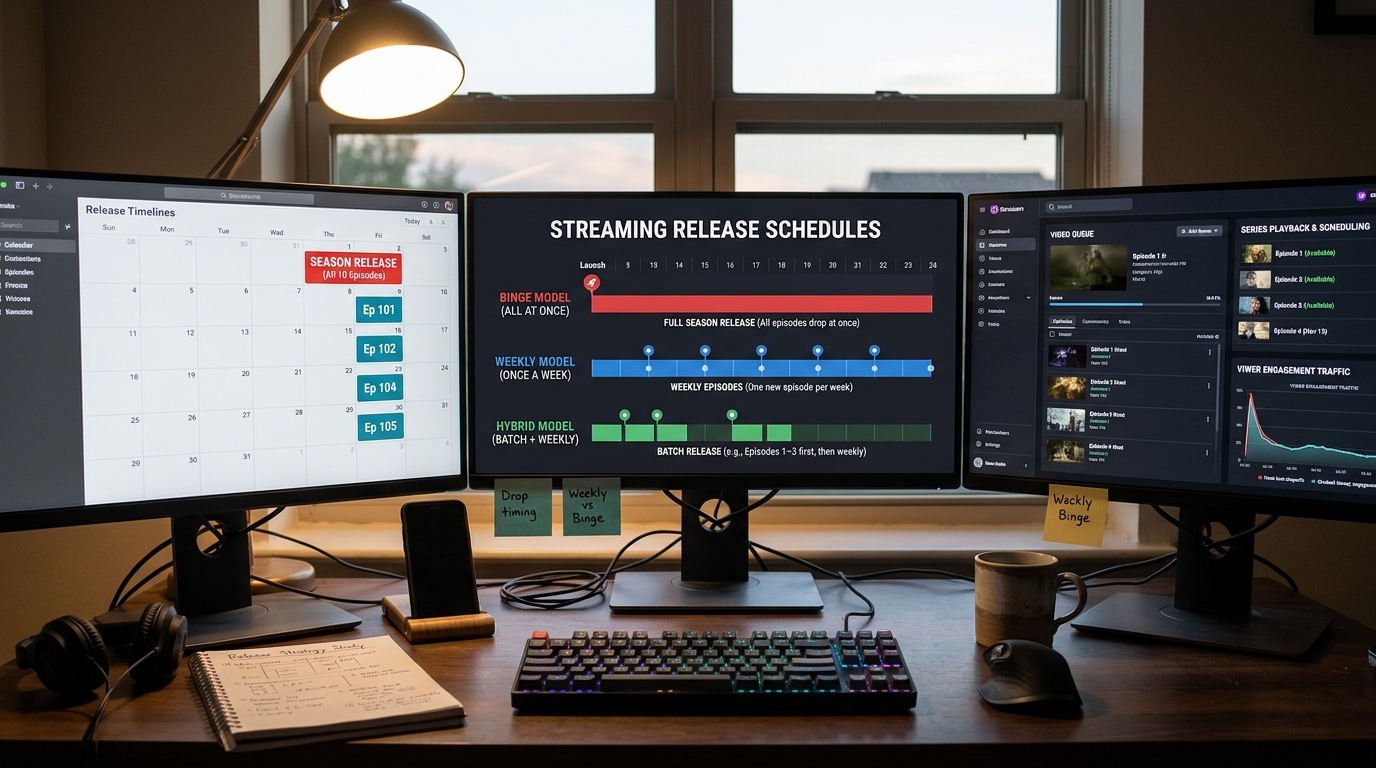
The phrase “new episode Wednesday” can mean different things depending on the service, territory and release strategy. Some shows appear one episode at a time, some drop complete seasons, and others divide a season into two or three batches. Meanwhile, a platform's public calendar may list a premiere date without specifying the exact time or whether the schedule applies worldwide. Understanding these differences is useful for anyone planning group watches, avoiding spoilers or deciding when to subscribe.
The key is to separate three questions: when the season starts, when each episode becomes available and where that schedule applies. If one answer is missing, the calendar is incomplete. It is better to record uncertainty than turn a likely pattern into a false guarantee.
Weekly releases create an ongoing conversation
A weekly rollout gives viewers time to revisit details, compare theories and discuss character decisions between episodes. It also gives a series a longer presence in public conversation. For mysteries, a seven-day pause can turn a quiet clue into a subject of debate. For comedies or episodic dramas, the familiar rhythm can become a pleasant appointment rather than an exercise in suspense.
The disadvantage is that a long break between episodes can be frustrating for viewers who prefer narrative continuity. People who join midway through a season may also struggle to avoid spoilers. Neither reaction is incorrect. The schedule encourages a particular style of engagement, but your preferred viewing pace may differ from the platform's promotional strategy.
Full-season drops favor control and immersion
When every episode arrives together, the viewer decides whether to watch one installment a week or finish the story over a weekend. This can be especially satisfying for tightly connected plots whose details are easier to remember over shorter intervals. A complete season is also convenient for travelers or households arranging a specific shared viewing window.
However, all-at-once availability can produce social pressure to finish quickly. A major twist may appear in online discussion only hours after launch, and people with less free time can feel excluded. Binge viewing can also blur the individual construction of episodes. A carefully designed cliffhanger loses its intended interval when the next installment begins automatically in seconds. Control is valuable, but it is still worth choosing a pace intentionally.
Split seasons create several miniature premieres
A growing number of release strategies combine immersion with pauses by grouping episodes into batches. Prime Video's announced third season of The Rings of Power is one example: four episodes on November 11, 2026, two on November 18 and the final two on November 25. This gives viewers a significant opening movement while preserving two additional dates for discussion and anticipation.
A batch is not simply a longer episode. It changes the shape of the audience's attention. The first set may establish multiple conflicts together, while the gap before later installments invites reflection. For viewers with limited evenings, a batch can feel like homework if it arrives alongside other releases. Break it up if needed. The fact that four episodes are available does not mean they must be consumed at once.
Broadcast schedules still influence streaming
Not every series is produced primarily for an on-demand platform. Traditional networks and regional broadcasters may air episodes at specified local times, with streaming access following either immediately or after a delay. International rights can produce further differences. A program marketed as a Thursday broadcast in one country may become available on another day through a local distributor.
This is why “premieres tonight” should be read alongside the location and service that issued the claim. A network's linear broadcast time is not automatically the same as the associated app's release time. In some markets, catch-up rights expire after a set period. If you depend on on-demand viewing, confirm that the episode remains available long enough for your intended schedule.
For how those patterns influence your actual experience, see our comparison of weekly episodes and full-season drops.
Time-zone conversions require a stated starting point
If a platform announces a release at 9 p.m. Eastern, you can calculate the corresponding time elsewhere. But many announcements give only a date. That absence matters. Assuming midnight in your local territory can lead to checking an app several hours early. Daylight-saving changes can introduce another source of mistakes when comparing regions.
Record the original time zone next to the stated time rather than replacing it with an unexplained conversion. If the provider describes a global simultaneous launch, check its official local display. If it describes country-by-country windows, do not expect identical clock times. No universal “Netflix time” or “Prime Video time” should be applied automatically to unrelated services, programs or territories.
Release schedules affect subscription costs
A weekly eight-episode season may span more than one billing period depending on when you join. An all-at-once drop can be completed in a single month, while split releases may fit somewhere between. For viewers subscribing only for one show, release cadence is therefore a financial detail as well as a storytelling choice. It can be sensible to wait for a season to finish before starting a new plan.
Waiting has a tradeoff. You may miss discussion while the show is current, and spoilers can be harder to avoid. Decide which benefit matters more to you: watching alongside the community or concentrating the whole story into a short subscription. The best choice depends on preference and budget, not on a single rule that every fan should follow.
Trailers and calendars do not always explain the rollout
Marketing frequently emphasizes the first release date while relegating episode details to a separate announcement. A poster promising a season on November 11 might refer to one episode, several episodes or the complete season. Read the platform's full schedule before setting repeated reminders or organizing a watch party. If the later dates are not published, label them unknown rather than assuming a weekly pattern.
Be especially cautious with third-party episode guides assembled before release. They may contain placeholders, estimated titles or dates inherited from previous seasons. When an official schedule contradicts an older listing, update your records. Correcting a small calendar error early is easier than discovering that an expected episode has not appeared on the night everyone planned to watch.
Sources and useful viewing resources
The HBO weekly rollout and Prime Video batch release offer documented contrasting examples. Individual platforms can change schedules, and this guide is not a universal release-time promise.